According to the Louisiana Personal Injury Lawyer Blog's account of the case, the buyers thought they'd done everything right. Before closing on a home in Houma, they had it inspected by Terminix, and the sellers, an estate, had already disclosed that the house carried a history of termite trouble. The sale went through as-is. Then the buyers started renovating and found termite and water damage far worse than anyone had mentioned. They sued. They lost. Louisiana's appellate court found that the sale's as-is language held, because the buyers had never exercised their legal right to open the walls and confirm what a visual inspection alone could not show them.
That case did not turn on whether termites were present. Everyone already knew they were. It turned on paperwork, on what an inspection report actually promises versus what a buyer assumes it promises, and on a legal standard that rewards whoever reads the fine print more carefully. If you're buying or selling a home in Terrebonne Parish, that is the part of the process worth understanding before you're the one standing in a gutted kitchen wondering what your contract actually protected.
What a Termite Report in Louisiana Actually Covers
Louisiana Administrative Code § XXV-121 identifies LPCA-143 and LPCA-143A as forms for a Wood Destroying Insect Report. The report tells a lender and a buyer whether a licensed inspector has seen visible evidence of wood-destroying insects in accessible parts of a structure.
That last phrase carries more weight than most people give it. The report explicitly excludes hidden and inaccessible areas. It is not a home inspection. It does not open walls. It does not test for rot, mold, or moisture, only for insects, and only where an inspector could see them without dismantling anything. A clean WDI report tells you nobody found evidence of an active problem in the accessible crawl space, attic, and sill plate. It does not tell you the house is termite-free.
The Clock Nobody Mentions Until It Matters
Here is the detail that catches people off guard. Louisiana regulation requires that a WDI report carry a guarantee: if live subterranean termites are found in any readily accessible area within 90 days of the inspection date, the pest control company has to treat the property without charge. That guarantee is genuinely useful protection.
Real estate closings slip. Financing takes longer than expected, an appraisal comes back low and gets renegotiated, a title issue needs clearing. In most transactions a two-week delay is a shrug. With a termite report, a delay that pushes you past that 90-day window means the guarantee has lapsed. That can complicate the timing of deals that are already fragile.
Why the Calendar Matters More in Houma Than Elsewhere
This is where timing in southeast Louisiana gets specific. Formosan subterranean termites, the destructive invasive species that dominates termite activity across the Gulf Coast, swarm on a predictable seasonal schedule that typically runs from around Mother's Day through late June. They fly at dusk on warm, humid, windless evenings, and when a colony swarms near a house, the termites can show up in numbers substantial enough that residents document them collecting under streetlights and porch fixtures.
Kevin Dawson, general manager of Pied Piper Pest Control, said in FOX 8's coverage of the 2026 swarm season:
"This termite season can really get people bent out of shape. I just want them to stay calm."
That advice is worth applying to closings as much as porches. If your WDI inspection happens in March or April, ahead of a spring closing, and that closing slips into June because of a routine financing delay, the closing can overlap with the weeks when swarming activity is heaviest and most visible. A house that had no active infestation in April can show fresh swarmer activity in June, not because anything got worse, but because that's simply when this species flies. Sellers and agents who understand this timing can plan the WDI inspection to land close to the actual closing date rather than early in the process,
The Downtown Houma Exception
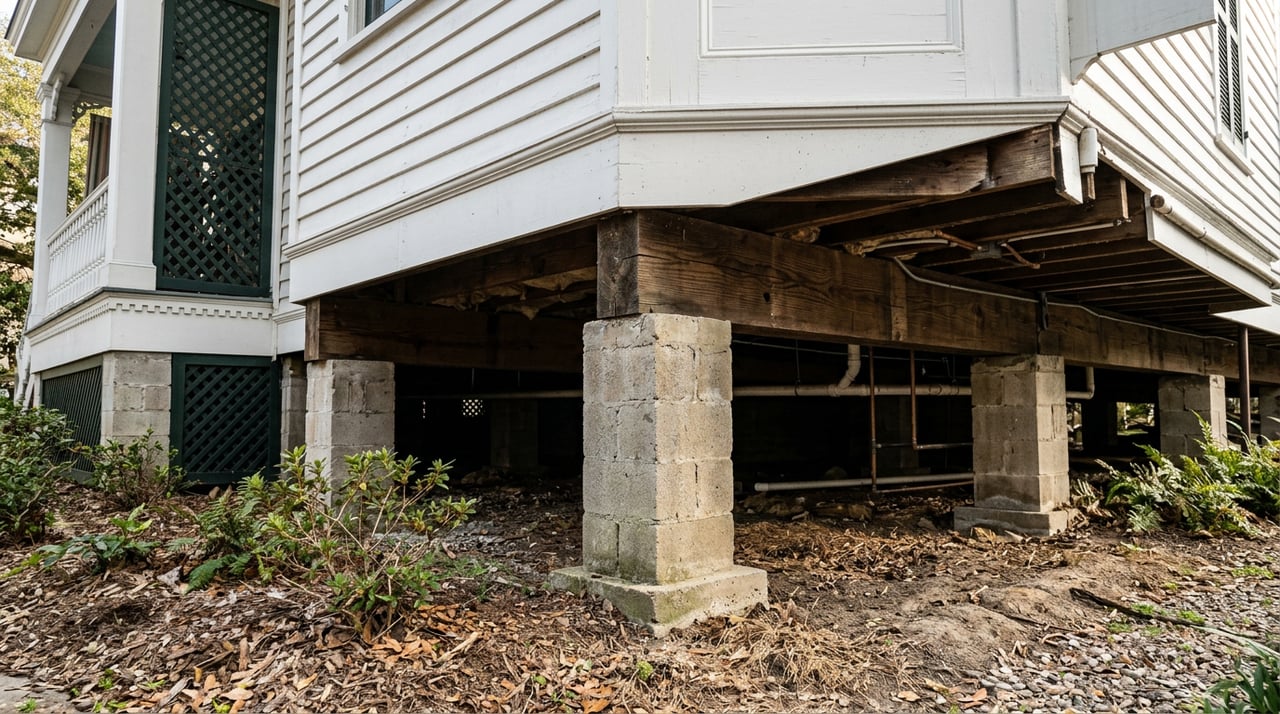
There's a common assumption that older homes carry more termite risk, and in downtown Houma's historic district, where structures can be a hundred years old or more with original wood windows and stone foundations, that assumption feels intuitive. The construction detail that undercuts it: a lot of that housing stock sits on raised pier-and-beam foundations, and according to LSU AgCenter guidance, raised construction is actually easier to protect against Formosan termites than a slab foundation, because the underside of the house is completely accessible for inspection. Termites have to travel up through a limited number of entry points, the support piers, porch connections, wood-to-ground contact, or utility lines, and an inspector can check every one of them without cutting into anything.
That doesn't mean an old raised house is risk-free. It means the age of a home is a weaker signal of termite risk than most buyers assume, and the foundation type is a stronger one. A well-maintained pier-and-beam home from the historic district, the kind of property the Houma Restoration District Commission works to preserve, can be genuinely easier to verify than a newer slab home where the same entry points are sealed under concrete and inaccessible to any visual inspection at all.
The Disclosure Form Is Doing More Work Than the Termite Report
According to Nolo, Louisiana law requires most sellers of one-to-four unit residential property to complete a Property Disclosure Document, a separate form from the WDI report, and deliver it to the buyer no later than when an offer is made. If it arrives after an offer, the buyer gets a 72-hour window to cancel the contract without penalty and get any earnest money back. Steeg Law reports that, as of January 1, 2018, sellers filling out that form no longer have a "No" option, including for termites and wood-destroying insects. The choices are "Yes" or "No Knowledge" only.
This is the mechanism that actually decided the case described above. The sellers had disclosed the prior termite history. What the buyers lacked wasn't information, it was the follow-through of exercising their own contractual right to inspect further once that disclosure was on the table. A termite report and a disclosure form together create a paper trail that protects whoever actually reads and acts on them, not whoever simply assumes the paperwork covered everything.
A short checklist worth keeping if you're on either side of a Houma closing involving an older home:
- Ask when the WDI inspection date will land relative to your projected closing date, and push for it to happen close to closing rather than at contract signing
- Understand that "no evidence found" describes accessible areas only, not a guarantee against everything behind a wall
- If the disclosure form shows any termite history, treat that as an invitation to inspect further, not a box that's already been checked for you
- For raised historic homes, ask whether the crawl space is genuinely accessible, since that accessibility is what makes the inspection meaningful in the first place
A Few Questions Worth Asking Directly
Who pays for the WDI inspection in a Houma sale? It's negotiable in the purchase contract, though practice across Louisiana often defaults to the seller covering it.
Does an existing termite bond transfer to a new owner? Often, yes, though it varies by pest control company and contract, so ask for the specific agreement in writing before closing rather than assuming coverage carries over automatically.
What happens if my closing slips past the 90-day guarantee window? The guarantee will have lapsed, so ask your lender what inspection requirements apply to your loan.
None of this is about being afraid of an old house in Houma, or of the insects that come with a warm, humid coastline every spring. It's about knowing which piece of paper is actually doing the protecting, and when its clock runs out. If you're weighing a purchase in the historic district, a sale of a longtime family home, or anything in between, the team at Good Earth Realty has walked enough of these closings to help you time the paperwork right the first time.
This article is general information, not legal, tax or financial advice. Consult a qualified professional about your situation.