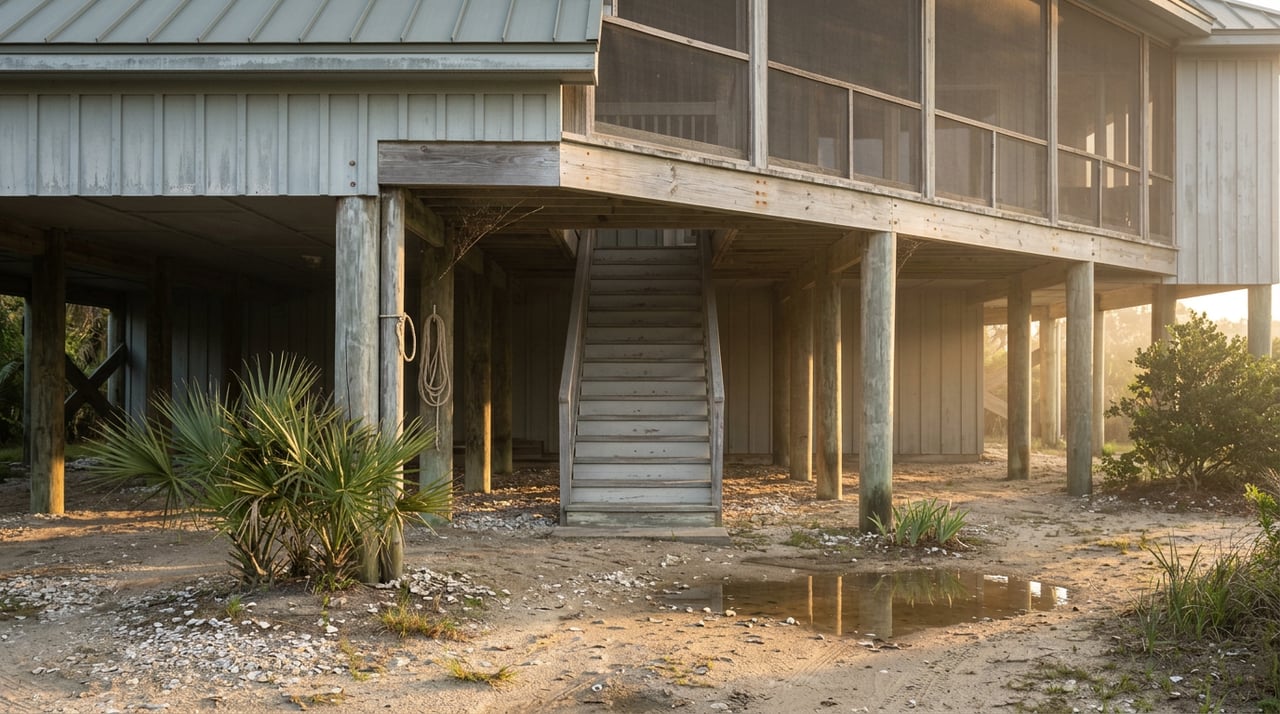
Pull up a handful of Cocodrie listings side by side and the square footage stops being useful fast. A small waterfront lot or a bare boat slip can run anywhere from $50,000 to $200,000. A three- or four-bedroom stilt house on that same stretch of water can run $200,000 to $600,000, for camps that, from the road, look close to identical. Same tin roof, same pilings, same screened porch facing the same bayou.
The gap isn't finish level or square footage. It's what's underneath the house.
The Ground Is the Variable the Search Filters Don't Show
Ask around Cocodrie long enough and one dividing line keeps coming up: south of the Sevin Canal, a large share of the camps sit on leased ground, not owned lots. The structure is yours. The dirt under it belongs to someone else, and you pay to keep the camp where it stands.
You won't find a filter for this on any listing site, but the market tells on itself anyway. Scroll through enough camp descriptions in this stretch of Terrebonne Parish and you'll notice how often "OWNED LAND!!" shows up in all caps with the exclamation points doubled, sometimes tripled, right at the top of the listing. Agents don't shout about a feature unless the alternative is common enough that buyers need to be told they're getting the better version. That habit of over-flagging owned ground is itself the clearest evidence that leased ground is the local default, not the exception.
A camp built the same year, on the same size lot, with the same layout, can sell for less simply because the buyer inherits a ground lease instead of a deed to the dirt.
What Owned Land Actually Buys You
The difference shows up in three places once you get past the listing photos.
Financing changes first. A conventional mortgage lender wants collateral it can foot, which means real property, structure and land together. A camp on leased ground often pushes buyers toward cash purchases, private financing, or chattel-style loans that treat the structure more like the mobile and manufactured homes common in this part of the coast, where lenders willing to finance anything other than a primary residence are already a short list.
Long-term equity changes second. Own the lot and every dollar of appreciation in the ground itself is yours. Lease it and you're building equity in a structure sitting on someone else's asset, with a lease payment that can be renegotiated or, depending on the terms, non-renewed.
Resale changes third, and this is the one that shows up hardest in the numbers. A leased-land camp can only sell to the slice of buyers comfortable with cash or private terms. An owned-land camp can sell to that same slice plus everyone who needs a bank. Shrink the buyer pool and you shrink both the price ceiling and the speed of a sale.
None of this makes a leased-land camp a bad purchase. Plenty of weekend fishing camps have changed hands for cash for generations without anyone blinking. It does mean two camps that look the same on a listing page are not competing in the same market, and treating them as comparable is where a buyer's math goes wrong.
The Median Price Is Noisy on Purpose
Here's where it gets more interesting than a simple two-tier price story. Pull the median sale price for Cocodrie from two different twelve-month windows earlier this year and you get two different answers. One snapshot puts the trailing median at $277,500, up 6% from the year before. Another, pulled just weeks apart, shows $180,000, down 31%.
That's not a typo and it's not bad data. It's what happens when a neighborhood sells a handful of homes a month. One snapshot recorded two sales in the trailing month. Another recorded just one. With a permanent population estimated around 300 and a housing stock dominated by second homes, Cocodrie doesn't generate enough monthly closings for a median to behave the way it does in a subdivision with hundreds of annual sales. A single high-end owned-land camp closing in one window, or a single leased-land camp closing in another, can swing the whole number by six figures.
The lesson isn't to distrust the median. It's to stop leaning on it as the load-bearing fact. In a market this thin, land tenure is the more stable signal. It tells you which price band and which buyer pool a camp belongs to before a single closing has to confirm it.
Why 160 Days Isn't a Red Flag Here
The second number worth sitting with is time on market. Across different segments of Cocodrie listings pulled in 2026, days on market ranged from about 62 at the fast end to well over 260 at the slow end, against a national average sitting in the low 50s to high 50s in those same snapshots. That's two to five times longer than a typical suburban listing, and it would look alarming anywhere else.
Here it's closer to a feature of how the market actually clears. A camp on leased land is waiting for a specific kind of buyer: someone comfortable paying cash or arranging private terms, who wants this stretch of water badly enough to skip conventional financing. That buyer doesn't show up every week. A camp on owned land can move faster because it's competing for a wider pool, but even then it's still selling into a place where weekend camp shoppers, not year-round movers, make up most of the demand.
Long days on market in Cocodrie usually means the listing is waiting for the right match, not that something is wrong with the camp.
Questions Worth Asking Before You Fall for the View
The view sells itself in Cocodrie. It's the paperwork that trips people up. Before you get attached to a specific camp, it's worth working through a short list with your agent:
- Is the land owned or leased, and if leased, who holds the lease? The parish, a private landowner, and a marina association all come with different terms.
- What is the annual lease payment, and when does it renew or expire?
- Does your intended lender finance structures on leased ground, or does this purchase need to be cash or privately financed?
- How does the lease status change your resale pool five or ten years from now?
None of these questions show up on a listing sheet. All four change what you should be willing to pay.
What's Actually Changed on the Ground
The investment in Cocodrie right now is real, and it's easy to see if you drive down for the day. CoCo Marina has been through a recent renovation of both the marina and its restaurant, with the redone dining room and dock getting consistent praise from visitors who remember the older version. That kind of reinvestment matters for property values along the water it touches, separate from the tenure question, and it's one more reason the neighborhood's price data can't be read as one flat market. A camp near a freshly renovated marina and a camp on a quiet leased-land canal a mile away are answering to different demand curves even before you factor in what's under the foundation.
The last-stop landmarks that anchor day-to-day life here, places like Cajun Bait and Cecil Lapeyrouse Grocery for supplies, or Harbor Light Marina and Tradewinds of Cocodrie for boat launches, aren't going to show up in a comp report. But they're part of what a buyer is actually purchasing when they buy into this stretch of the parish, and they're worth walking past before you make an offer.
Two Questions Worth Asking Early
Is buying on leased land always a worse deal? Not necessarily. It can mean a lower entry price and a workable arrangement for a cash buyer who wants a weekend camp and isn't focused on long-term land equity. It's a worse deal only if you go in expecting conventional financing or a fast, wide resale pool later.
How do I find out whether a specific camp sits on owned or leased ground before I tour it? This is exactly where a local agent earns their keep. Tenure status isn't always obvious from photos or the listing description, and it should be one of the first questions asked, not one discovered at the title search.
If you're comparing camps in Cocodrie and the price spread has you confused, that confusion usually clears up once someone walks you through what's actually underneath each one. If you already have a fishing camp in your sights and want the fuller checklist on permits, utilities and insurance, our companion guide on buying a fishing camp in Cocodrie covers that ground. For the tenure and pricing questions this piece raises, Good Earth Realty Houma knows this stretch of water well enough to tell you which camps are worth the wait and which aren't. Let's find your next camp, dirt included or not, with a local agent who already knows the difference.